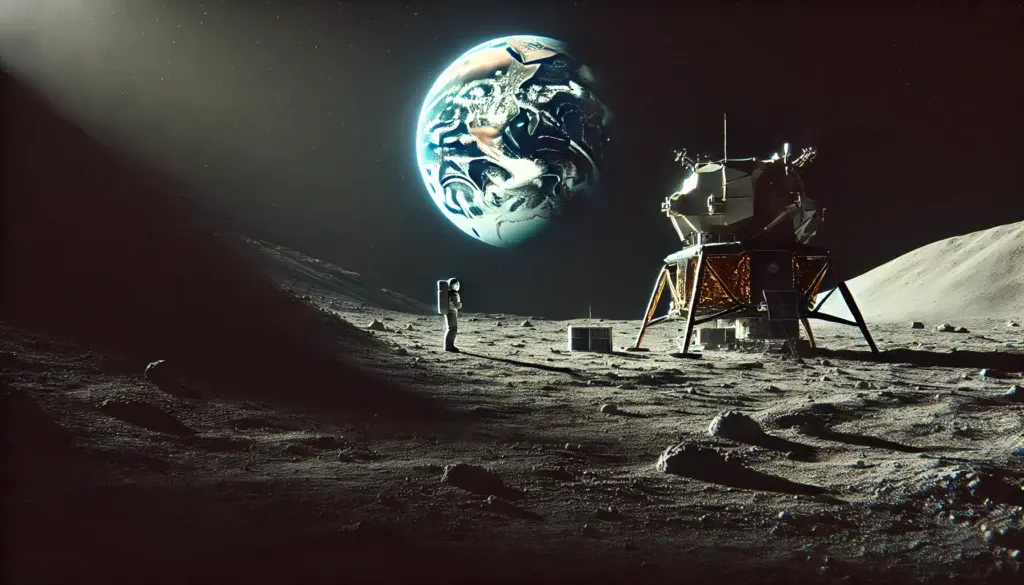
There are questions that linger around the edges of what we’re told to accept as truth.
Questions that don’t scream, but quietly press against the mind.
One of the strangest — and most enduring — is this:
Is the Moon hollow?
At first glance, it sounds impossible. A fringe idea tucked somewhere between ancient myth and late-night radio. But the Hollow Moon Theory has persisted for decades, surviving scientific rebuttal, resurfacing in new forms, and continuing to inspire fascination across science fiction, conspiracy circles, and alternative history communities.
The draw isn’t just the idea itself — it’s what it implies.
That something so familiar, so constant in our sky, may not be what authority has insisted it is.
This is where the inquiry begins.
The Signal Beneath the Noise
The Hollow Moon Theory suggests that the Moon may not be a fully solid natural satellite, but instead could contain large internal cavities or even be an engineered structure placed in Earth’s orbit. Supporters point to seismic data from the Apollo missions, the Moon’s unusual density, its perfectly matched size ratio during eclipses, and myths that speak of a time before the Moon existed. Mainstream science explains these features through geological models and formation theories, though some anomalies remain debated. Whether or not the Moon is hollow, the real significance of the theory lies in what it represents—our instinct to question the familiar, explore the unknown, and recognize that mystery still exists in the world around us.
Summarize this content with AI
Where the Hollow Moon Theory Came From
Though the idea has appeared in various mythologies and esoteric traditions throughout history, the modern form of the theory took shape in the 20th century.
In the 1960s and 70s, during the Apollo missions, scientists observed something that fueled decades of speculation: when the Apollo spacecraft intentionally crashed parts of its hardware onto the lunar surface, the Moon rang — like a bell — for nearly an hour.
The phrase that circulated afterward was simple, unsettling, and difficult to ignore:
“The Moon rang like a bell.”
This was reported in NASA transcripts and noted by researchers. The observation didn’t prove the Moon was hollow — there are geological reasons why seismic waves behave differently there — but the phrasing burned itself into the public imagination.
Around the same time, authors and researchers proposing alternative histories began to interpret the Moon not as a natural celestial body, but as something else:
- An artificial construct
- A vessel
- A megastructure
Something placed — not formed.
This was not the mainstream scientific view, and still isn’t.
But the idea survived.
Because some questions don’t go away just because they’re inconvenient.
Hollow Moon Theory Explained
The Hollow Moon Theory proposes that the Moon is either entirely hollow or contains large internal cavities significantly larger than would be expected in a naturally formed satellite.
Supporters of this idea suggest:
1. The Moon’s Density Is Unusual
The Moon is less dense than Earth. To some, this hints at a hollow interior or engineered internal architecture.
2. The Craters Are Too Shallow
Despite massive impacts, lunar craters don’t go very deep. They appear as though the surface is reinforced beneath — like plating.
3. It Shouldn’t Be Where It Is
The Moon’s orbit, size, and tidal effects on Earth line up strangely well — stabilizing Earth’s rotation, climate, and seasonal structure.
Some researchers refer to it as “too perfect.”
4. Ancient Cultural References
Numerous mythologies speak of a time “before the Moon,” suggesting that its arrival may have been seen, recorded, or remembered.
None of these claims alone confirm anything.
But they form a pattern that people feel compelled to question.
The Evidence People Point To
Those who explore this theory rarely do so casually. The interest is often rooted in a pattern-seeking instinct — the sense that anomalies deserve attention.
Here are the most commonly cited points of hollow moon theory evidence:
Seismic Activity Patterns
When Apollo astronauts placed seismometers on the Moon, impacts created vibrations unlike those on Earth — vibrations that persisted. This fueled the idea of internal resonance.
Unusual Composition
The surface contains large amounts of titanium and isotopes not commonly found in natural formations of its supposed origin.
Matched Size-Ratio to Earth
The Moon is unusually large relative to Earth — a rare configuration in the solar system.
Orbital Coincidence
The Moon is positioned so that it appears the same size as the Sun during an eclipse.
Perfectly.
Not larger. Not smaller.
The odds of that happening randomly are astronomically low.
Of course, mainstream science has explanations for most of these phenomena — density gradients, geological composition, and orbital evolution — but these explanations often require layers of assumptions that are difficult to independently verify.
The question becomes not just what we know, but how we know.
And who we trust to define what is known.
Alternative Perspectives
The Hollow Moon Theory exists at a crossroads between scientific speculation, myth, symbolism, and philosophical inquiry.
The Scientific View
Geologists, astronomers, and astrophysicists generally agree:
- The Moon formed from a collision between Earth and a Mars-sized object billions of years ago.
- Its lower density is due to its unique developmental history.
- The seismic ringing was caused by dry, rigid composition rather than hollowness.
This view relies on accepted models of planetary formation.
The Alternative Interpretation
Researchers outside the mainstream propose:
- The Moon may be a constructed object, possibly ancient.
- It could have been placed intentionally to stabilize Earth.
- It may serve as an observational platform — or something older, with a purpose no longer understood.
This perspective is not presented as fact — only as possibility.
But possibility carries a kind of gravitational pull.
Cultural and Psychological Significance
The fascination with a hollow Moon says something about us.
The Moon has always been more than a satellite. It has been:
- A mirror of the human psyche
- A symbol of mystery and cycles
- A companion to consciousness
To question the Moon is to question the structure of reality itself — not just scientifically, but emotionally.
People don’t just ask “Is the Moon hollow?”
They are really asking:
- How much of what we are told is incomplete?
- What else lies hidden in plain sight?
- How much of our world is built on assumptions we’ve never examined?
This is why the discussion persists.
Not because it must be proven, but because it invites us to think.
The Impact of Hollow Moon Theory on Science and Society
Even without being accepted, the theory exerts influence.
1. It Forces Science to Address Uncomfortable Data
Scientific progress often begins with anomalies.
Doubt is a catalyst.
2. It Shapes Cultural Narratives
It fuels art, literature, and exploration of the unknown.
3. It Challenges the Boundaries of What We Allow Ourselves to Consider
Not all inquiry needs to lead to certainty.
Some questions exist to expand the mind.
Whether the Moon is hollow is less important than what happens when someone stops taking the world at face value.
Why This Matters Now
We live in a time when information is abundant, yet understanding is fractured.
Truth is layered. Narratives compete.
The Hollow Moon Theory sits at the threshold between:
- Skepticism and imagination
- Science and myth
- The seen and the unseen
Some are drawn to this question because they believe the Moon holds literal secrets.
Others are drawn because it symbolizes the unknown.
Both are valid paths.
The real significance lies in the willingness to look up at something everyone thinks they already understand — and refuse to look away.
A Quiet Ending
We may never know the full answer.
The Moon doesn’t rush to reveal itself.
It just hangs there — patient — reflecting light but offering silence.
Whether hollow or solid, natural or constructed, ancient or designed…
It reminds us that mystery is not a flaw in the world — it’s part of its structure.
Some truths are not lost.
They are simply waiting.