In the summer of 1952, unidentified objects appeared on radar screens around Washington, D.C. Air traffic controllers reported unusual movements, pilots were dispatched to investigate, and newspapers began asking whether something unknown was operating in American airspace.
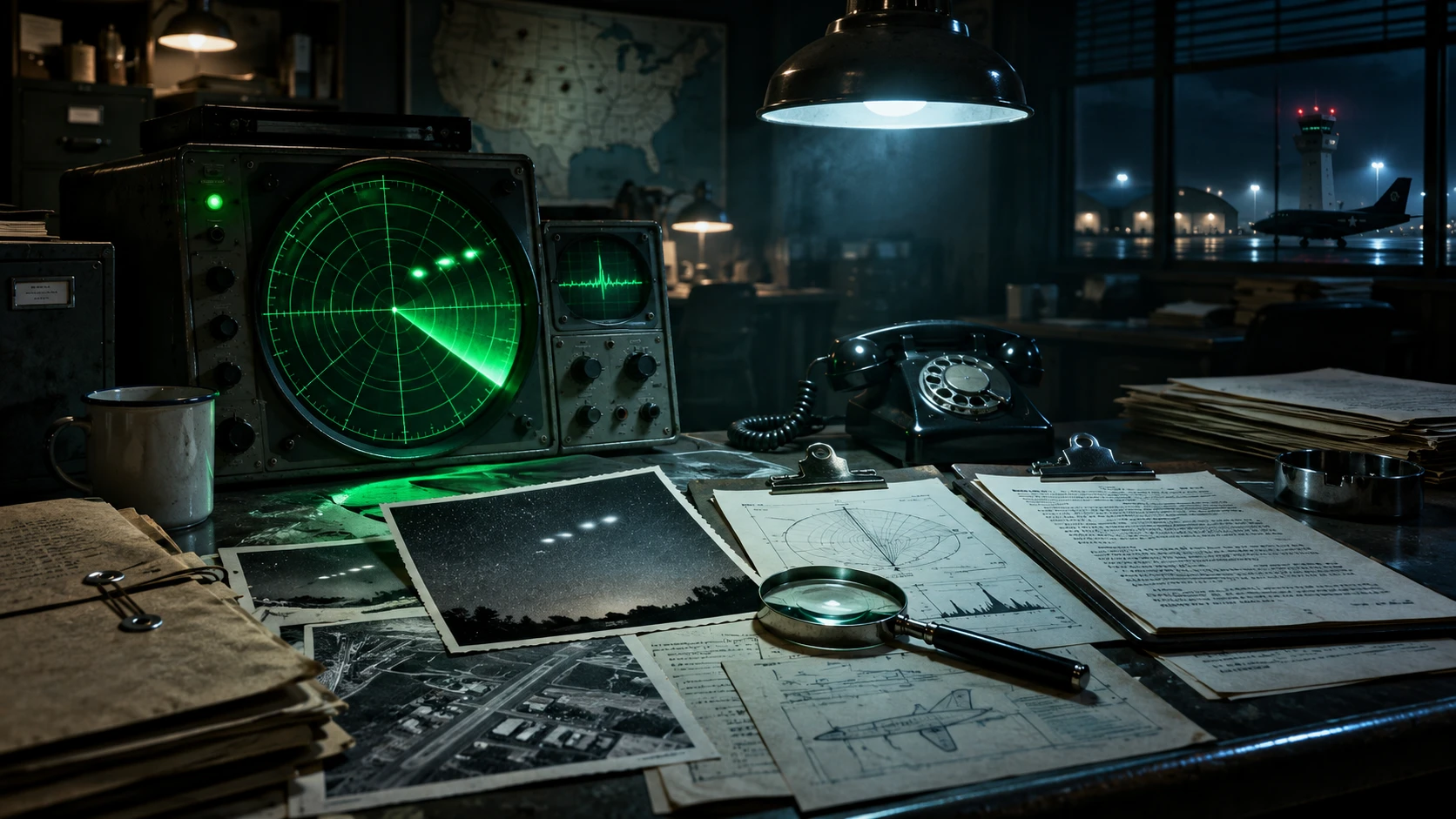
The United States Air Force was already investigating UFO reports. But during the early Cold War, these incidents raised questions that went far beyond the possibility of extraterrestrial visitors. Could an unfamiliar aircraft belong to the Soviet Union? Were American pilots encountering atmospheric phenomena they didn’t understand? And how seriously should the military treat reports that seemed to challenge conventional explanations?
At the center of these questions was a government investigation known as Project Blue Book.
Operating from 1952 until 1969, Project Blue Book became the Air Force’s longest-running investigation of unidentified flying objects. Together with its predecessor programs, it accumulated reports of 12,618 sightings. Most received conventional explanations, but 701 remained officially unidentified.
Those figures are often presented as evidence either for or against the existence of extraterrestrial visitors. The actual history is more complicated.
Project Blue Book was an investigation shaped by Cold War anxieties, scientific uncertainty, public fascination, and a military institution that had responsibilities beyond solving mysteries.
Understanding what happened requires looking beyond its final conclusions and into the records themselves.
THE SIGNAL // CASE FILE BRIEF
WHAT WE KNOW
Project Blue Book operated from March 1952 to December 1969 at Wright-Patterson Air Force Base in Ohio. Along with earlier Air Force programs, it examined 12,618 reported UFO sightings. The Air Force ultimately classified 701 as unidentified and concluded that its investigations had found no evidence of extraterrestrial spacecraft or an unexplained threat to national security.
WHAT’S BEING CLAIMED
Critics have argued that the program sometimes prioritized public reassurance over rigorous investigation. Others maintain that its extensive records show how easily aircraft, balloons, atmospheric effects, and astronomical objects can be mistaken for extraordinary phenomena. Some of its unresolved cases continue to attract attention.
WHAT REMAINS UNKNOWN
The precise causes of hundreds of historical sightings remain undetermined. The records also leave questions about the quality, consistency, and limitations of individual investigations—and whether certain cases might have been better understood with modern instruments.
Before Blue Book: The UFO Wave That Changed American Skies
The story begins before Project Blue Book existed.
On June 24, 1947, private pilot Kenneth Arnold reported seeing nine unusual objects moving near Mount Rainier in Washington State. Arnold described their extraordinary speed and an unusual motion that newspapers soon associated with the phrase flying saucers.
The account captured public attention. Reports of strange aerial objects began arriving from across the United States.
The timing mattered.
World War II had ended only two years earlier. Jet aviation was advancing rapidly, the Cold War was taking shape, and military planners were increasingly concerned about unfamiliar aircraft and weapons systems.
An unusual object in American airspace was not simply an astronomical curiosity. It could represent a technological development that the United States had failed to anticipate.
The Air Force therefore had a practical reason to investigate.
On December 30, 1947, military officials authorized an effort to collect and evaluate UFO reports that might have national security implications.
The investigation became known as Project Sign.
Project Sign and Project Grudge: The Investigations Before Blue Book
Project Sign: Taking the Reports Seriously
Project Sign began its work in early 1948, operating through the Air Force’s technical intelligence organization at Wright Field, later associated with Wright-Patterson Air Force Base.
Investigators collected witness statements, examined reports from military personnel, and looked for explanations involving aircraft, weather phenomena, astronomical objects, or unknown technology.
Some accounts resisted straightforward identification.
Sign’s published final report did not establish an extraterrestrial origin. Instead, it acknowledged that the available evidence could not conclusively settle every reported sighting.
That uncertainty left the Air Force with an uncomfortable problem: it could explain many incidents, but it could not confidently explain them all.
Project Grudge: A More Skeptical Direction
In February 1949, Project Sign gave way to Project Grudge.
Grudge adopted a more skeptical approach, emphasizing conventional explanations such as mistaken observations, balloons, astronomical objects, and fabricated stories.
Its August 1949 report concluded that UFO reports generally resulted from familiar causes rather than extraordinary aircraft.
Yet reports continued, and the military’s responsibility to assess unusual activity in American skies remained.
By late 1951, Air Force intelligence officials were reconsidering how these investigations should be conducted.
The next program would be larger, better organized, and far more visible.
Project Blue Book Begins in 1952
In March 1952, Air Force Director of Intelligence Major General Charles P. Cabell established Project Blue Book.
The program operated from Wright-Patterson Air Force Base near Dayton, Ohio, under the Air Technical Intelligence Center.
Captain Edward J. Ruppelt became its first director.
Ruppelt sought to make UFO investigations more systematic. Rather than treating reports as isolated curiosities, his team developed procedures for collecting witness information, examining photographs, contacting radar operators, and consulting scientific specialists.
The military needed to know whether a reported object could represent a genuine security concern. It also needed a method for distinguishing unusual observations from ordinary phenomena.
These objectives were not always easy to reconcile.
A thorough scientific investigation could leave questions unresolved. A military organization, however, was under pressure to provide timely explanations and reassure the public.
That tension would follow Blue Book throughout its existence.
How Project Blue Book Investigated UFO Reports
Blue Book’s work was less dramatic than its reputation suggests.
Much of it consisted of questionnaires, correspondence, telephone calls, scientific consultations, and comparisons with known activity in the sky.
Investigators wanted precise details: when and where an object appeared, how long it remained visible, its apparent shape and motion, local weather conditions, and whether other observers reported the same event.
They could consult astronomers, aviation authorities, meteorologists, laboratories, and military personnel.
A bright light might turn out to be Venus observed through atmospheric haze. A seemingly stationary object could be a high-altitude balloon. An unusual radar return might result from atmospheric conditions.
Reports were generally evaluated as identified, unidentified, or lacking sufficient information for a reliable conclusion.
An unidentified designation did not mean investigators had discovered extraordinary technology. It meant the available evidence had not produced a satisfactory identification.
That distinction is central to understanding the entire program.
The 1952 Washington, D.C. UFO Incidents
Only months after Blue Book began, a series of extraordinary reports placed the investigation under intense public scrutiny.
During July 1952, radar operators around Washington National Airport and Andrews Air Force Base detected unusual targets. The incidents were accompanied by reports of strange lights, and military aircraft were sent to investigate.
Newspapers covered the events extensively.
For Americans already concerned about Soviet aircraft and unfamiliar military technology, unexplained activity near the nation’s capital was especially unsettling.
On July 29, Air Force Director of Intelligence Major General John Samford addressed reporters at a major Pentagon press conference.
Officials discussed the possibility that unusual atmospheric conditions, particularly temperature inversions, could have produced misleading radar returns and apparent visual anomalies.
A temperature inversion occurs when a layer of warmer air sits above cooler air. Under certain circumstances, atmospheric conditions can bend radio waves and create misleading radar indications.
This provided a plausible explanation for some observations, although the interpretation of the entire incident remained disputed.
The Washington sightings demonstrated how quickly an unexplained event could become a national security concern and a public controversy.
They also revealed something important about Blue Book’s role: the Air Force was investigating aerial reports while simultaneously managing their effect on public confidence.
The CIA, the Robertson Panel, and the Problem of Public Perception
By January 1953, UFO reports had attracted attention from the Central Intelligence Agency.
The CIA convened a group of scientists known as the Robertson Panel, chaired by physicist H. P. Robertson.
The panel reviewed selected UFO evidence and considered whether the phenomenon presented a threat to national security.
Its members did not find convincing evidence of extraterrestrial spacecraft. But they identified another concern: widespread UFO reports could overwhelm intelligence reporting systems or create opportunities for psychological manipulation during a national emergency.
The panel recommended public education intended to reduce sensationalism and help people recognize familiar aerial phenomena.
This recommendation has remained controversial.
Critics argue that encouraging authorities to diminish public fascination with UFOs risked creating an institutional bias against unusual reports. Supporters view the recommendation in its Cold War context, when officials worried that false alarms could interfere with the identification of genuine threats.
The documented concern about public perception was real.
Whether it affected the handling of particular Blue Book cases requires examining those investigations individually.
Project Blue Book Special Report No. 14
In 1955, the Air Force released one of the program’s most important analytical documents: Project Blue Book Special Report No. 14.
Prepared by Battelle Memorial Institute, the study examined 3,201 UFO reports using statistical methods.
The researchers considered factors such as observation quality, witness reliability, and characteristics of reported objects.
The analysis found that many incidents had plausible conventional explanations. It also identified a meaningful group of cases that remained unexplained after examination.
One noteworthy finding was that unidentified reports were not confined to the poorest-quality observations.
The study nevertheless concluded that the available evidence did not demonstrate technology beyond contemporary scientific understanding.
Both observations deserve attention.
Some reliable witnesses genuinely encountered things they could not identify. That does not establish that the objects were extraordinary, but neither does it justify dismissing every unresolved case as careless observation.
Scientific uncertainty is not a verdict. It is a description of what the evidence can—and cannot—support.
When Secret Aircraft Became UFOs
There was another complication Blue Book investigators could not always discuss publicly.
During the 1950s and 1960s, American intelligence agencies developed and operated classified reconnaissance aircraft, including the U-2.
These aircraft flew at altitudes unusual for the period. Under certain lighting conditions, observers could see brilliant reflections from aircraft operating far above ordinary commercial traffic.
To someone unfamiliar with the technology, such a sight could appear genuinely extraordinary.
Later declassified CIA histories described how secret reconnaissance flights contributed to UFO reports and how Blue Book personnel sometimes checked sightings against classified flight information.
This introduces an important contradiction into the program’s history.
The government was investigating apparently unknown aircraft while parts of that same government were operating aircraft whose existence it could not freely acknowledge.
In some cases, the mystery was real to the witness even though the explanation was already known within classified military programs.
That does not explain every Blue Book case. It does demonstrate why public reports and official conclusions must be understood within their historical setting.
The Socorro Incident: A Case Blue Book Could Not Close
On April 24, 1964, police officer Lonnie Zamora reported a disturbing encounter near Socorro, New Mexico.
While pursuing a speeding vehicle, Zamora heard a loud roar and noticed what appeared to be a flame in the distance.
He diverted from the pursuit to investigate.
According to his account, he encountered an unusual, egg-shaped object near the ground, with two figures nearby. He then reported seeing the object rise and depart with a powerful sound.
Investigators examined the location, interviewed witnesses, and considered possible conventional explanations.
J. Allen Hynek, the astronomer serving as Blue Book’s scientific consultant, personally examined the case.
The Air Force ultimately left the Socorro incident unidentified.
Its importance lies in the combination of a detailed witness account, an investigated location, and the failure to establish a definitive explanation.
Still, the case has limitations. The observations were brief, the physical evidence was not conclusive, and no independently verified extraordinary craft was recovered.
Socorro remains one of the best-known examples of what an unresolved Blue Book case actually means.
The Michigan Sightings and the Swamp Gas Controversy
Two years later, Blue Book faced another highly publicized dispute.
In March 1966, residents of Michigan reported unusual lights and objects around Dexter and Hillsdale.
Hynek investigated and suggested that marsh gas could explain aspects of some reports.
The explanation quickly became reduced in newspaper coverage to the now-infamous phrase swamp gas.
For many witnesses, it sounded dismissive of their experiences.
Michigan Congressman Gerald Ford criticized the Air Force’s handling of the incidents and called for a more thorough congressional examination.
The House Armed Services Committee held a hearing in April 1966.
The controversy highlighted a recurring weakness in official investigations: even a plausible scientific explanation may fail to persuade when authorities communicate it without sufficient clarity or sensitivity to what witnesses believe they experienced.
It also raised broader questions about whether Blue Book had the resources and independence required for difficult investigations.
J. Allen Hynek: From Skeptic to Persistent Questioner
Few people are more closely associated with Project Blue Book than astronomer J. Allen Hynek.
Hynek began working with Air Force UFO investigations during the Project Sign era and remained involved as a scientific consultant for many years.
He approached the subject skeptically and explained numerous reports through astronomy and other familiar phenomena.
Over time, however, he became increasingly dissatisfied with how some investigations were conducted.
Hynek believed that certain unusual reports deserved more careful scientific attention than they received. He also criticized the social stigma surrounding witnesses and researchers who took the subject seriously.
His changing perspective is sometimes presented as proof that UFOs must have been extraterrestrial.
That interpretation goes further than his involvement establishes.
Hynek’s importance lies in his insistence that an unresolved observation should be studied carefully rather than forced into either an extraordinary or dismissive conclusion.
After Blue Book ended, he continued civilian UFO research and founded the Center for UFO Studies in 1973.
The Condon Report and the End of Project Blue Book
By the late 1960s, the Air Force faced growing criticism over the program’s effectiveness.
In response to calls for independent scientific evaluation, the University of Colorado conducted a study under physicist Edward U. Condon.
The resulting 1968 publication, Scientific Study of Unidentified Flying Objects, became known as the Condon Report.
Its overall conclusion was that continued intensive UFO investigation was unlikely to produce major scientific advances.
Some individual cases examined by the study remained unexplained, but the report did not establish an extraterrestrial explanation.
The findings were reviewed by a panel associated with the National Academy of Sciences, which broadly supported the study’s conclusions.
Critics questioned aspects of the report’s methodology and argued that some unresolved cases deserved greater consideration.
Nevertheless, the Air Force accepted the assessment.
On December 17, 1969, Secretary of the Air Force Robert C. Seamans Jr. announced the termination of Project Blue Book. Its remaining operations ended in January 1970.
The official investigation had reached its conclusion.
The unanswered questions had not disappeared.
What Happened to the 701 Unidentified Cases?
Across Project Sign, Project Grudge, and Project Blue Book, the Air Force recorded 12,618 UFO reports between 1947 and 1969.
Of those, 701 retained an unidentified classification—approximately 5.6 percent of the total.
These numbers require careful interpretation.
The 12,618 figure represents the broader Air Force investigative history, not sightings collected exclusively during Blue Book’s 1952–1969 operating period.
Likewise, the 701 cases do not represent 701 confirmed extraordinary aircraft.
Some involved potentially interesting witness testimony. Others had limited information, disputed interpretations, or observational difficulties that prevented confident identification.
Cases with insufficient information were also distinguished from those formally classified as unidentified.
The Air Force concluded that its investigations had found no evidence of extraterrestrial vehicles, technology beyond contemporary scientific understanding, or an unidentified threat to national security.
That is the official conclusion—not proof that every sighting was correctly explained.
The existence of unresolved files leaves room for further historical analysis, but it does not establish a particular explanation for those events.
What Project Blue Book’s Declassified Files Reveal Today
Project Blue Book’s records are now held by the National Archives, where researchers can examine case files, photographs, correspondence, investigative reports, and administrative documents.
The collection provides an unusually detailed picture of how the U.S. military responded to UFO reports during the Cold War.
There is no need to rely entirely on later retellings. Original records are available to compare claims, witness accounts, and official assessments.
The files also show why historical UFO research is difficult.
Some reports contain extensive information. Others consist largely of brief descriptions, incomplete measurements, or conflicting testimony.
A classification written in an official record is only as reliable as the investigation supporting it.
That makes Blue Book valuable for reasons beyond the possibility of extraterrestrial life. Its history reveals how institutions assess uncertainty, how secrecy can complicate public understanding, and how scientific questions become entangled with political and military responsibilities.
Its legacy also reaches into modern discussions of unidentified anomalous phenomena, now commonly called UAP.
The terminology has changed, and modern sensor systems can collect information unavailable to Blue Book investigators. But a familiar question remains: how should authorities investigate observations that appear unusual without assuming either an extraordinary origin or an ordinary explanation before the evidence is examined?
Project Blue Book’s Unfinished Legacy
Project Blue Book did not prove that extraterrestrial spacecraft were visiting Earth.
It also did not explain every report it investigated.
What it left behind was something more complicated: a substantial historical record of ordinary misidentifications, genuine uncertainty, institutional pressures, scientific disagreement, and extraordinary claims that often exceeded the available evidence.
The official investigation ended in 1969. Its files continue to invite examination.
Perhaps some unresolved cases would have straightforward explanations if they occurred today, with modern cameras, satellite data, and multiple independent sensors. Others may remain impossible to reconstruct because the necessary evidence was never collected.
Neither possibility requires blind belief or automatic dismissal.
Project Blue Book’s history is a reminder that identifying what we don’t know can be just as important as explaining what we do.
And sometimes, the most revealing part of a mystery isn’t what appeared in the sky.
It’s how we responded when we couldn’t explain it.
UNRESTID — THE CURIOUS MIND NEVER RESTS.