The strangest detail in some alien abduction accounts isn’t the spacecraft, the unfamiliar beings, or even the missing time. It’s the children.
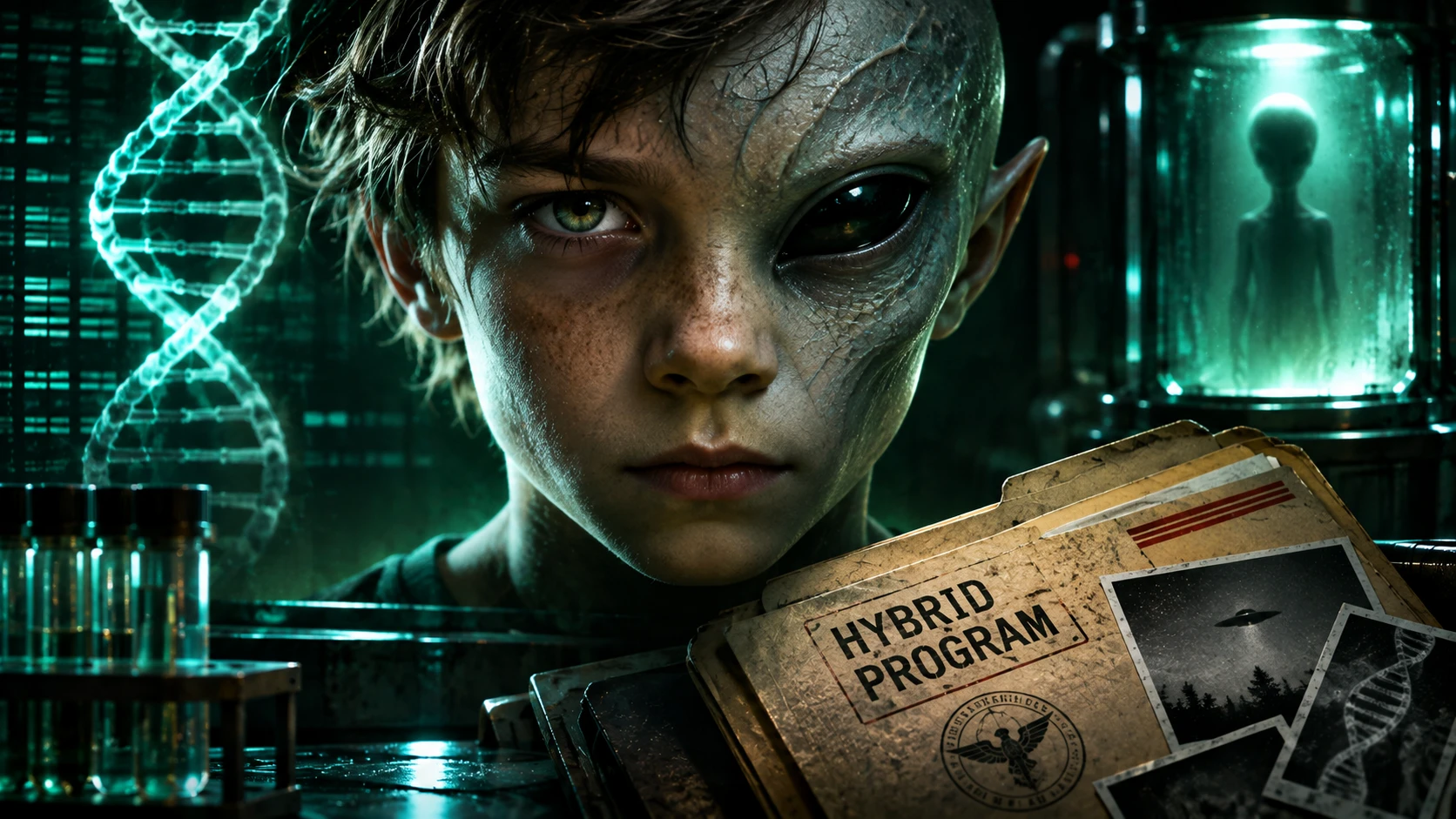
For decades, people who believe they’ve experienced extraterrestrial encounters have described something considerably more disturbing than a brief examination aboard an unknown craft. Some recall medical procedures involving reproduction. Others describe being shown infants or children who appear partly human and partly something else.
From those accounts emerged the alien hybrid program theory: the claim that nonhuman intelligences are secretly combining their biology with ours, creating a new population whose purpose remains unknown.
Depending on who tells the story, the alleged program is an experiment, an attempt to preserve a dying civilization, or part of a much larger plan involving humanity’s future. Some versions even claim that government institutions are involved.
It’s an extraordinary proposition. But unlike many modern internet mysteries, its development can be traced through decades of published accounts, researchers, and increasingly elaborate interpretations.
The real question is whether that history reveals evidence of an actual biological program—or something equally fascinating about memory, belief, and the human experience of the unknown.
THE SIGNAL // CASE FILE BRIEF
WHAT WE KNOW
The alien hybrid program theory developed largely from UFO abduction accounts, particularly those popularized during the 1980s and 1990s. Researchers including Budd Hopkins, David Jacobs, and John E. Mack documented people reporting reproductive procedures and encounters with supposedly hybrid children. These accounts exist, but no independently verified extraterrestrial-human hybrid has been demonstrated.
WHAT’S BEING CLAIMED
Some experiencers and investigators allege that nonhuman beings collect human reproductive material to create hybrid offspring. Proposed motives include genetic survival, adaptation to Earth’s environment, scientific research, and eventual integration into human society. Recent allegations have also suggested secret government involvement.
WHAT REMAINS UNKNOWN
The origins of individual experiences, the reliability of some recovered memories, and the reasons particular narratives recur remain subjects of investigation and debate. No reproducible genetic, biological, or documentary evidence has established that the alleged hybrid program exists.
What Is the Alien Hybrid Program Theory?
At its simplest, the theory proposes that an advanced nonhuman intelligence is conducting a long-term reproductive or genetic experiment involving humanity.
The central claim is not merely that extraterrestrials visit Earth. It is that they have a specific interest in human biology and are deliberately producing offspring that combine human and nonhuman characteristics.
Accounts vary considerably. Some describe the collection of eggs or sperm during alleged abductions. Others involve unexplained pregnancies, medical examinations, or encounters with children possessing unusual physical features.
More elaborate versions suggest several generations of hybrids, each supposedly becoming more human in appearance and behavior. A few investigators have argued that the eventual objective is integration into ordinary human society.
These are separate claims, not an established sequence of events.
For the theory to be demonstrated, researchers would first need reliable evidence of nonhuman visitors, then evidence of reproductive intervention, and finally independently testable proof that hybrid offspring actually exist.
A mysterious light in the sky cannot establish a genetic experiment. An unexplained personal experience cannot, by itself, demonstrate the creation of an entirely new population.
That distinction becomes increasingly important as the story develops.
The Origins: Betty and Barney Hill
The modern history of alien abduction is closely associated with Betty and Barney Hill, a New Hampshire couple who reported an unusual encounter while driving through the White Mountains in September 1961.
They described observing an unfamiliar light that appeared to follow their vehicle. In the aftermath, they became concerned about a gap in their recollection of the journey.
Over the following years, their story developed through Betty’s dreams and hypnosis sessions conducted by psychiatrist Benjamin Simon in 1964.
During those sessions, the Hills described being taken aboard a craft and subjected to medical examinations by unfamiliar beings.
Their account did not establish the elaborate hybrid breeding program later associated with alien abduction research. Nevertheless, its medical and reproductive imagery helped establish a narrative framework that would become increasingly recognizable.
The story reached a much wider audience through John G. Fuller’s 1966 book The Interrupted Journey.
Today, the couple’s papers are preserved in the University of New Hampshire’s archival collection, allowing researchers to study the historical record rather than relying entirely on later retellings.
The Hills’ experience remains culturally significant. Whether their recovered memories accurately represented physical events is a separate and unresolved evidentiary question.
How the Hybrid Theory Took Shape in the 1980s and 1990s
The reproductive interpretation became much more prominent through the work of investigators Budd Hopkins and David Jacobs.
Budd Hopkins and Intruders
Hopkins began collecting accounts from people who believed they had experienced alien abductions.
His 1987 book Intruders: The Incredible Visitations at Copley Woods centered on reports involving reproductive examinations, unusual pregnancies, and alleged encounters with nonhuman offspring.
Hopkins interpreted similarities between testimonies as indications of a coordinated program.
For supporters, those recurring details suggested that witnesses were describing related experiences rather than unrelated events.
Critics identified a different possibility: people exposed to similar expectations, interview techniques, and cultural stories might develop or recount similar narratives without experiencing the same external event.
David Jacobs and the Hybridization Agenda
Historian David M. Jacobs expanded the theory in Secret Life (1992) and The Threat (1998).
Jacobs proposed that abduction experiences reflected a systematic reproductive undertaking. In his interpretation, successive generations of hybrids were becoming increasingly capable of passing as human.
That idea shifted the narrative from isolated medical encounters to a supposed long-term project with consequences for humanity.
His conclusions were based substantially on testimony, including accounts obtained through hypnosis. They have not been independently established through genetic or biological testing.
John E. Mack and the Experience Itself
Harvard psychiatrist John E. Mack approached the phenomenon differently.
In his 1994 book Abduction: Human Encounters with Aliens, Mack examined the experiences of people who reported contact with nonhuman entities.
He was interested not only in whether the accounts were physically literal but also in their emotional, psychological, and potentially transformative significance.
Mack’s openness to extraordinary interpretations attracted considerable criticism from other scientists.
The three researchers helped establish alien abduction as a subject of sustained public fascination, but they did not agree on every aspect of its meaning.
And none produced independently verified evidence of an extraterrestrial-human hybrid.
Why Would Aliens Want to Create Human Hybrids?
The theory’s proposed motives reveal just how speculative its underlying assumptions remain.
One explanation suggests genetic survival. According to this version, an extraterrestrial civilization has lost its reproductive viability and requires human genetic material to continue.
Another proposes environmental adaptation: hybrids might combine the visitors’ abilities with human characteristics suited to life on Earth.
A third describes scientific experimentation, with humanity treated as a species being studied through controlled reproductive procedures.
Perhaps the most unsettling version proposes gradual integration. Rather than invading openly, an advanced civilization would supposedly create descendants capable of living among humans without attracting attention.
The difficulty is that none of these motives comes from a verified nonhuman source.
They are human interpretations of reported experiences, frequently shaped by the assumptions of the investigators developing them.
A theory can offer an internally consistent explanation for a collection of stories without demonstrating that the explanation is true.
Missing Time, Hypnosis, and the Reliability of Memory
One of the biggest challenges facing the alien hybrid program theory involves the way its supporting testimony has been collected.
Many abduction accounts include missing time, fragmented recollections, or memories emerging during hypnotic regression.
Hypnosis can produce compelling subjective experiences. It does not, however, reliably recover an objective recording of forgotten events.
Psychological research has shown that suggestion can increase both false recollection and confidence in memories that are inaccurate.
In a 2002 study published in the Journal of Abnormal Psychology, researchers including Susan Clancy and Richard McNally examined memory distortion among people who reported alien abduction experiences.
The researchers found that participants reporting recovered abduction memories were particularly susceptible to certain laboratory measures of false recall.
That finding does not prove every reported experience was invented. It does demonstrate why vividness, sincerity, and emotional intensity cannot substitute for independent evidence.
A person may be entirely convinced that something happened and still be mistaken about its cause.
Recognizing that possibility does not require treating the person with ridicule or dismissing the distress associated with the experience.
Sleep Paralysis and the Feeling of an Unseen Presence
Some reported abductions share striking features with sleep paralysis.
During sleep paralysis, a person can become conscious while temporarily unable to move. The experience may be accompanied by vivid perceptions of figures in the room, pressure on the body, unusual sounds, or an overwhelming sense of another presence.
These events can feel indistinguishable from waking reality.
Research involving people reporting alien abduction experiences has identified cases in which sleep paralysis and associated hallucinations offered plausible explanations.
But sleep paralysis should not be treated as a universal answer. Not every abduction report occurs around sleep, and different experiences may have different causes.
There is also a cultural dimension.
Accounts of night visitors, mysterious paralysis, and beings interacting with sleeping humans existed long before the modern UFO era.
The imagery changes across cultures and historical periods. The underlying experiences sometimes appear remarkably familiar.
That does not prove every account has the same origin. It suggests that human perception and cultural expectations deserve serious consideration alongside extraordinary interpretations.
Could Human-Alien Hybrids Exist Biologically?
The concept raises a scientific question that fiction rarely needs to answer: could organisms from entirely different evolutionary histories reproduce together?
On Earth, successful reproduction depends on substantial biological compatibility. Even closely related species can face genetic, chromosomal, or developmental barriers.
An extraterrestrial organism might not use DNA at all. If it did, there is no reason to assume its genetic system would be compatible with human reproduction.
An advanced civilization might hypothetically possess technologies capable of manipulating unfamiliar biological systems. But imagining such capabilities is not evidence that they exist or have been used.
Modern genetic engineering demonstrates that biological material can be altered under controlled laboratory conditions. It does not demonstrate extraterrestrial intervention.
No publicly verified specimen or independently replicated genetic analysis has established the existence of a human-extraterrestrial hybrid.
To make that claim scientifically credible, researchers would need an identifiable specimen, a documented chain of custody, reproducible laboratory findings, and convincing evidence that the material could not be explained through known terrestrial biology.
A paper about genetic manipulation alone cannot establish alien involvement.
And until extraterrestrial life is independently identified, scientists lack even a verified reference genome against which to compare such a claim.
The Matt Gaetz Alien Hybrid Program Allegation
The theory received renewed attention in 2026 when former U.S. Representative Matt Gaetz discussed an alleged government-connected breeding program.
During an interview with Benny Johnson, Gaetz claimed that an individual wearing a U.S. Army uniform had approached him while he served in Congress.
According to Gaetz, the individual described secret facilities where captured nonhuman beings were supposedly being used in a breeding program involving humans, with the alleged goal of producing hybrids capable of communicating with extraterrestrial civilizations.
The claim was extraordinary even by the standards of UFO disclosure discussions.
But its evidentiary status is important.
Gaetz was recounting what an unidentified individual allegedly told him. He did not publicly demonstrate that the facilities existed, identify participants through independently verifiable records, or produce biological evidence establishing such a program.
He also acknowledged that he had not verified the information.
A person with political experience can receive an extraordinary allegation without that allegation becoming an established government finding.
The public account is therefore evidence that Gaetz made the claim, not evidence that the described program exists.
The Pentagon’s All-domain Anomaly Resolution Office, or AARO, reported in its 2024 historical review that it had found no verifiable evidence of a U.S. government extraterrestrial technology recovery or reverse-engineering program.
That assessment does not independently adjudicate every conceivable hybridization allegation, but it provides important context for claims of hidden nonhuman programs.
Are Alien Hybrid Stories Modern Versions of Older Folklore?
Long before flying saucers entered popular culture, people told stories about mysterious beings who took children, visited sleeping humans, or interfered with reproduction.
European changeling traditions described infants supposedly exchanged by supernatural beings. Other folklore involved encounters with strange visitors who crossed the boundary between the human world and something beyond it.
Modern abduction accounts sometimes echo those older themes.
The similarities are interesting, but they can be interpreted in very different ways.
Some paranormal theorists see recurring motifs as possible evidence of a persistent phenomenon described through changing cultural language.
Folklorists and psychologists can instead examine how enduring human concerns—bodily autonomy, reproduction, vulnerability, and unfamiliar outsiders—take different forms across generations.
Neither interpretation becomes proof merely because the stories resemble one another.
The comparison does, however, help explain why hybrid narratives are so psychologically powerful. They transform a distant cosmic mystery into something deeply personal.
The unknown is no longer simply watching from the sky.
It has entered the most private parts of human life.
What Evidence Would Actually Confirm an Alien Hybrid Program?
A convincing investigation would need more than similar witness accounts or increasingly detailed theories.
It would need independently verifiable material evidence, such as a securely documented biological specimen or genetic findings that qualified laboratories could reproduce.
For allegations involving government facilities, relevant evidence might include authenticated records, independently corroborated testimony, and physical material that can be examined without relying on anonymous intermediaries.
Investigators would also need to test competing explanations, including contamination, mistaken identification, fraud, and ordinary biological variation.
No such independently verified collection of evidence has publicly established the alien hybrid program theory.
That does not mean every person reporting an encounter is dishonest. It means that testimony about an experience and proof of its proposed cause are different things.
The most useful question is not whether a story sounds convincing.
It is whether the explanation survives careful investigation when the original storyteller is no longer the only source of information.
The Mystery Beneath the Theory
The alien hybrid program theory occupies an unusual place in the history of UFO belief.
Its development can be documented. Its major advocates can be identified. Its recurring themes can be studied. Researchers have examined some of the psychological mechanisms that may contribute to extraordinary experiences.
Yet the central biological claim remains unproven.
Perhaps its persistence tells us something about the way human beings respond to mysteries that touch our identity, our bodies, and our place in the universe.
Or perhaps there are aspects of individual experiences that deserve further study without accepting the elaborate explanations built around them.
Curiosity does not require us to believe the most extraordinary interpretation. Skepticism does not require us to mock the question.
The boundary between possibility and evidence matters.
And until something crosses that boundary, the alien hybrid program remains a story we can trace, examine, and question—but not a biological reality we can verify.
UNRESTID — THE CURIOUS MIND NEVER RESTS.