Every image you’ve ever seen of a tesseract is, in a sense, incomplete.
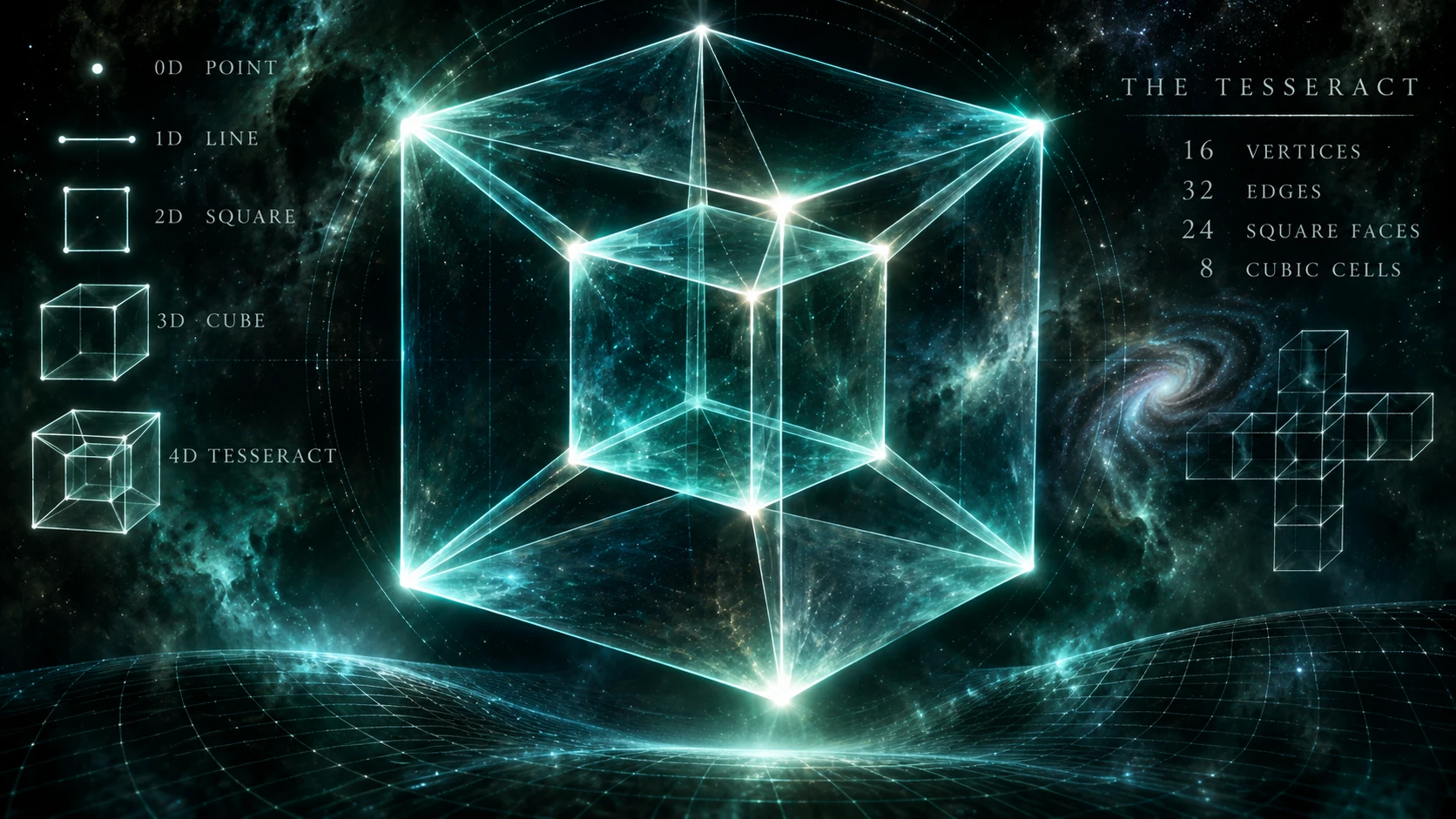
The familiar drawing of a cube suspended inside another cube, with lines connecting their corners, looks like an object that ought to exist somewhere. You can trace its edges, study its structure, and even watch computer animations of it rotating.
But what you’re looking at isn’t the object itself. It’s a three-dimensional representation of something that mathematics describes in four spatial dimensions.
A tesseract is a four-dimensional cube, also called a hypercube. It has 16 vertices, 32 edges, 24 square faces, and eight cubic cells. Its geometry is precisely defined, even though our eyes cannot directly perceive the additional spatial direction it occupies.
That distinction has fascinated mathematicians, physicists, artists, and writers for more than a century. It also raises an uncomfortable question about human perception: if a shape can be mathematically understood without being directly visualized, how much of reality might exist beyond the limits of our senses?
The answer begins with a surprisingly ordinary object: a cube.
THE SIGNAL // CASE FILE BRIEF
WHAT WE KNOW
A tesseract is a mathematically defined four-dimensional hypercube. It contains 16 vertices, 32 edges, 24 square faces, and eight cubic cells. Mathematicians can describe its structure, calculate its properties, and construct lower-dimensional projections of it.
WHAT’S BEING CLAIMED
Some theoretical physics models propose additional spatial dimensions beyond the three we experience. Popular fiction and paranormal interpretations have also associated higher dimensions with time travel, parallel realities, and unexplained phenomena.
WHAT REMAINS UNKNOWN
Whether our universe contains additional spatial dimensions is an open scientific question. No confirmed observation has demonstrated an accessible fourth spatial direction, and there is no established evidence connecting tesseracts or higher-dimensional geometry to paranormal events.
What Is a Tesseract in Simple Terms?
To understand a tesseract, consider how familiar geometric shapes are constructed.
A point has no length, width, or height. Extend it in one direction and you create a line segment. Extend that segment in a second, perpendicular direction and you create a square. Extend the square in a third direction and you create a cube.
The next step follows exactly the same mathematical pattern.
Imagine extending an entire cube in a new direction that is perpendicular to all three directions it already occupies.
The resulting object is a tesseract.
The difficulty isn’t that the process breaks any mathematical rules. It is that we cannot physically point toward this fourth spatial direction. Every movement available to us can be expressed using some combination of length, width, and height.
Mathematics, however, isn’t restricted to directions our bodies can experience.
A cube has six square faces forming its boundary. A tesseract has eight three-dimensional cubic cells forming its boundary in four-dimensional space.
These eight cells are not eight separate cubes placed beside one another in an ordinary room. They are components of a single four-dimensional geometric object.
The distinction is subtle, but it explains why the tesseract seems so strange when we attempt to draw it.
How Many Sides Does a Tesseract Have?
A tesseract has several kinds of geometric components, depending on what we mean by sides.
Geometric feature | Tesseract |
|---|---|
Dimensions | 4 |
Vertices (corners) | 16 |
Edges | 32 |
Square faces | 24 |
Cubic cells | 8 |
These numbers aren’t guesses or theoretical estimates. They follow directly from the mathematics of a four-dimensional hypercube.
For comparison, a square has four vertices and four edges. A cube has eight vertices, 12 edges, and six square faces.
Each increase in dimension changes the structure in a predictable way.
One way to describe a tesseract is with four coordinates: (x, y, z, w).
For a tesseract centered at the origin, each vertex can be represented by choosing either −1 or +1 for each coordinate.
Since there are two choices for each of four coordinates, there are 2 × 2 × 2 × 2 = 16 possible vertices.
You don’t need to visualize the fourth direction to calculate the result. The geometry remains consistent whether or not the human mind can picture it.
That is part of what makes higher-dimensional mathematics so powerful.
What Does a Tesseract Actually Look Like?
The best-known representation resembles a smaller cube floating inside a larger one, connected at corresponding corners.
It is often called a Schlegel diagram.
But it would be misleading to imagine that a genuine four-dimensional cube literally contains a smaller cube in that arrangement.
What we’re seeing is a projection.
A three-dimensional cube can be represented on a flat sheet of paper. The drawing might show two offset squares connected by diagonal lines. Those lines communicate depth, but the paper itself hasn’t gained a third dimension.
Something similar happens when a tesseract is projected into three dimensions.
Its four-dimensional structure is compressed into a form we can examine. Parts that are separated in higher-dimensional space may overlap, distort, or appear nested in the projection.
Computer animations can make this even more fascinating. As a simulated tesseract rotates through four-dimensional planes, its three-dimensional projection changes shape in ways that appear impossible for an ordinary solid object.
Edges seem to pass through one another. Interior regions appear to become exterior regions. The entire structure can look as though it is turning itself inside out.
Nothing supernatural is occurring.
The animation is displaying how a mathematically consistent object appears when represented in fewer dimensions than it actually possesses.
How Can We Imagine the Fourth Dimension?
In 1884, English schoolmaster and author Edwin Abbott Abbott published Flatland: A Romance of Many Dimensions.
The story follows inhabitants of a two-dimensional world who understand only the directions available within their plane.
Imagine a sphere passing through that world.
Its inhabitants wouldn’t see a complete sphere. Instead, they would encounter a changing circular cross-section: a small circle appearing, growing wider, then shrinking until it vanished.
From their perspective, the event would be deeply confusing. An object would seem to materialize from nowhere, change size without an obvious cause, and disappear.
We understand the event because we can picture the third dimension from which the sphere entered.
Now apply the same reasoning to ourselves.
If a four-dimensional object could intersect our three-dimensional world, we might observe a changing three-dimensional cross-section rather than the whole object.
Depending on the geometry and motion involved, an object might appear, transform, separate into distinct visible regions, and disappear as the intersection changed.
This doesn’t mean such events have been observed. It explains what certain mathematical cross-sections could look like.
The thought experiment raises a deeper question: perhaps our difficulty imagining a fourth direction says more about the limits of human perception than about the limits of geometry.
Who Invented the Tesseract?
The term tesseract is associated with British mathematician and writer Charles Howard Hinton, who explored higher-dimensional geometry during the late nineteenth century.
His 1888 book A New Era of Thought introduced readers to methods for reasoning about four-dimensional objects.
Hinton developed exercises involving arrangements of colored cubes, intended to help people understand spatial relationships beyond ordinary three-dimensional intuition.
His work reflected a wider intellectual fascination with the fourth dimension.
During this period, higher-dimensional geometry was becoming an increasingly serious mathematical subject. At the same time, writers and philosophers were using it to question whether human perception offered a complete picture of reality.
Hinton’s ideas spread beyond mathematics into literature and art.
In 1954, Salvador Dalí created Crucifixion (Corpus Hypercubus), portraying a crucifixion against an unfolded arrangement of eight cubes representing a tesseract’s three-dimensional net.
Just as a paper cube can be unfolded into six connected squares, a tesseract can be mathematically unfolded into eight connected cubes.
It remains one of the most striking examples of higher-dimensional geometry influencing visual art.
Is the Fourth Dimension Time or Space?
This is where discussions about tesseracts often become confusing.
The expression fourth dimension is used in two related but importantly different contexts.
The Fourth Spatial Dimension
In geometry, a fourth spatial dimension is an additional independent direction beyond length, width, and height.
It behaves mathematically like another direction of space, even though we cannot physically perceive it.
This is the dimension in which a tesseract is defined.
Time as the Fourth Dimension
In relativity, time is incorporated with three spatial coordinates into a four-dimensional structure called spacetime.
An event isn’t fully described merely by where it happens. We also need to know when.
For example, identifying the location of a lightning strike requires three spatial coordinates. Identifying the specific event also requires a time coordinate.
In 1908, mathematician Hermann Minkowski presented a geometric formulation of Einstein’s special relativity that brought space and time into a unified framework.
But time doesn’t behave exactly like another spatial direction.
The mathematical interval describing spacetime treats the temporal coordinate differently from the spatial ones. That distinction is fundamental to the causal structure of relativity.
A tesseract represents four spatial dimensions. Our familiar relativistic spacetime has three spatial dimensions and one temporal dimension.
They both involve four coordinates, but they are not interchangeable.
Is Time Really a Dimension?
Yes. In modern physics, time is an essential coordinate of spacetime, and its relationship with space has measurable consequences.
Einstein’s theories predict that clocks can tick at different rates depending on their motion and the gravitational conditions around them.
These effects have been repeatedly confirmed experimentally.
GPS provides an everyday example.
Because GPS satellites move rapidly, special relativity predicts that their clocks run slightly slower than comparable clocks on Earth’s surface. Because they orbit farther from Earth’s gravitational field, general relativity predicts a larger effect in the opposite direction.
Together, the effects make satellite clocks run approximately 38 microseconds faster per day than Earthbound clocks.
That difference must be accounted for to maintain accurate positioning.
Time therefore isn’t merely a philosophical addition to our description of reality. It is physically connected to the way the universe operates.
Still, recognizing time as a dimension doesn’t mean we can move through it as freely as we move across a room.
The mathematics of spacetime does not transform time into a corridor that we can enter, leave, or revisit at will.
How Many Dimensions Are There in the Universe?
The answer depends on whether we’re discussing mathematics or the physical universe.
In mathematics, spaces can have almost any number of dimensions. Researchers routinely work with high-dimensional structures, sometimes involving hundreds or thousands of independent coordinates.
In the physical world, observations are consistent with three extended spatial dimensions and one dimension of time.
However, some theoretical models propose more.
Early work by Theodor Kaluza and Oskar Klein explored the possibility of an additional dimension connected to attempts to unify gravity and electromagnetism.
Later developments in theoretical physics expanded the idea.
Many versions of superstring theory require ten spacetime dimensions, while M-theory uses eleven. In these frameworks, the extra spatial dimensions may be compactified—curled into structures too small to detect through ordinary observation.
Physicists have considered ways to search for evidence of extra dimensions using high-energy particle collisions and gravitational measurements.
The Large Hadron Collider has investigated phenomena that could be associated with certain extra-dimensional models.
So far, no confirmed experimental evidence has established the existence of additional spatial dimensions.
That absence doesn’t mean every theoretical possibility has been eliminated. It means the mathematical proposals remain ahead of direct experimental confirmation.
Could a Tesseract Allow Time Travel?
Science fiction often treats the tesseract as a mechanism for moving through time or crossing enormous distances.
The idea is visually compelling, particularly because the distinction between spatial and temporal dimensions can become blurred in fictional settings.
In Madeleine L’Engle’s novel A Wrinkle in Time, the term is associated with a way of bypassing ordinary distances through a higher-dimensional shortcut.
In the film Interstellar, a tesseract-like structure allows a character to perceive different moments through an elaborate higher-dimensional environment.
Marvel’s cinematic Tesseract, meanwhile, is a fictional artifact rather than a geometric hypercube.
These interpretations borrow language and imagery from mathematics, but they aren’t descriptions of what an actual mathematical tesseract does.
A four-dimensional cube has no inherent ability to transport matter, fold spacetime, or open a passage into the past.
Relativity does predict time dilation, allowing different observers to experience different amounts of elapsed time. In that limited sense, an observer can move into another observer’s future faster than they normally would.
Travel into the past is much more speculative. Some solutions to Einstein’s equations contain unusual paths through spacetime, but the physical conditions required to realize them have not been demonstrated.
The existence of a tesseract as a mathematical object provides no evidence that such journeys are possible.
Why Is the Fourth Dimension Connected to the Paranormal?
The connection between higher dimensions and the paranormal developed surprisingly early.
During the 1870s, German astronomer Johann Karl Friedrich Zöllner investigated claims made by spiritualist medium Henry Slade.
Zöllner proposed that certain alleged phenomena, such as knots appearing in closed loops of cord, might be explained by movement through a fourth spatial dimension.
The geometric reasoning was interesting.
Imagine a creature confined to a two-dimensional surface. A three-dimensional observer could potentially move an object off that surface, transport it elsewhere, and return it without passing through any barriers within the flat world.
To the two-dimensional creature, the movement could seem impossible.
By analogy, a hypothetical four-dimensional being might be able to navigate around three-dimensional barriers in ways that would appear extraordinary to us.
Zöllner interpreted his experiments through this framework, but the mediumistic claims were disputed and did not establish the existence of four-dimensional beings.
The same basic reasoning still appears in modern speculation involving apparitions, unexplained disappearances, interdimensional visitors, and unusual aerial phenomena.
The possibility is attractive because higher-dimensional mathematics describes arrangements that exceed familiar spatial intuition.
But the reasoning has a critical limitation.
Showing that a phenomenon could be imagined using additional dimensions does not establish that the phenomenon occurred, that extra dimensions physically exist, or that the proposed explanation is correct.
There is currently no verified scientific evidence that paranormal experiences result from objects or beings moving through an additional spatial dimension.
The geometry is legitimate. Its application to paranormal claims remains speculation.
Could a Four-Dimensional Object Exist in Our World?
A tesseract unquestionably exists as a mathematical construction. Whether a physical four-dimensional object can exist in our universe is a different question.
If there is an extended fourth spatial dimension, physical objects and fields might conceivably have properties that depend on it. But the consequences would depend on the laws governing that additional dimension.
There is no reason to assume that a four-dimensional object would behave like the dramatic projections seen in computer animations.
For instance, a changing three-dimensional cross-section could reveal only part of a higher-dimensional object. The full structure might remain inaccessible to an observer confined to three-dimensional space.
Researchers can describe these possibilities mathematically, just as they can describe spaces with many more than four dimensions.
But mathematical consistency alone does not guarantee physical existence.
A shape can be perfectly defined without appearing anywhere in nature.
Until evidence supports an additional spatial dimension, the tesseract remains a powerful geometric model rather than an object scientists have directly observed.
The Real Mystery of the Tesseract
The most remarkable thing about a tesseract isn’t that it might conceal a gateway to another world.
It’s that we can understand its structure without ever seeing the complete object.
We can count its vertices, calculate distances between points, describe rotations, create projections, and investigate relationships that our ordinary spatial intuition cannot grasp.
Mathematics allows us to reason beyond the limitations of direct perception.
That doesn’t establish the existence of hidden realms or higher-dimensional visitors. But it does reveal something significant about our relationship with reality.
Human experience is not the measure of everything that can be described, investigated, or understood.
The tesseract sits at the intersection of that realization and a much larger question: does the universe contain directions, structures, or properties that lie beyond our immediate experience?
For now, the fourth spatial dimension is a mathematical certainty and a physical possibility—not an observed feature of our everyday world.
And perhaps that’s compelling enough.
Because before we can discover what lies beyond the familiar, we have to recognize that the familiar may not be the whole picture.
UNRESTID — THE CURIOUS MIND NEVER RESTS.